
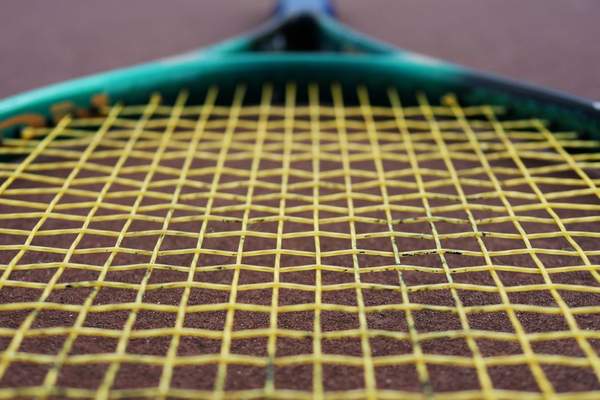
String tension can change the personality of a tennis racket almost as much as the string itself. Two identical frames can feel noticeably different when one is strung in the mid-40s and the other in the mid-50s. The useful question is not simply whether a higher or lower number is “better,” but how that number changes launch, feel, comfort, and confidence through the ball.
A few pounds can fine-tune a setup, but tension will not fix late contact or poor footwork. Think of it as a tuning control: choose a sensible racket and string first, then adjust the response.
What Tennis Racket String Tension Means
String tension is the pulling force applied to each string while a racket is being strung, normally expressed in pounds or kilograms. A request for 52 lb tells the stringer the reference tension to use during installation. It does not mean the string bed will remain at exactly 52 lb. Strings begin losing tension after stringing and continue to change with play, time, and temperature.
The racket should be your first reference point. Manufacturers normally provide a recommended tension range for each frame. Starting near the middle is sensible when you have no previous setup to compare.
Low vs High String Tension: What Changes?
Lower tension usually feels livelier and softer
At lower tension, the string bed deflects more at impact. Players often experience easier depth, a higher launch, a larger-feeling sweet spot, and a more forgiving response. This is why lower racket tension pounds can suit players who want help generating depth or who find their current setup too firm.
Lower tension can also improve comfort, especially with an elastic string such as multifilament or natural gut. Babolat notes that lower tension can contribute to comfort and power. String material and racket stiffness still matter, so the lowest possible number is not automatically better.
Higher tension usually feels firmer and more controlled
Increasing tension reduces string-bed deflection and usually lowers the launch response. Many players describe this as better string tension control because the ball feels less likely to spring deep when they accelerate. The trade-off is a firmer impact and less free depth.
The familiar rule of “higher tension for control, lower tension for power” is useful, but it is not a guarantee. USTA guidance has noted that small tension changes may affect trajectory and perceived consistency more than raw ball speed. Technique still has a much larger influence on accuracy.
String Type Changes the Right Number
The same tension can feel very different with different strings. A full bed of polyester at 55 lb is much firmer than a soft multifilament at the same reference tension. Copying another player’s number without copying the string type can therefore lead to a poor setup.
As a broad reference, Wilson currently suggests around 50–60 lb for nylon or natural gut, 46–56 lb for hybrid setups, and 44–54 lb for polyester. These are general starting ranges, not instructions for every racket. The frame’s recommended range and the string manufacturer’s guidance should take priority.
Polyester is commonly strung lower because it is inherently stiffer. If comfort is a priority, changing to a softer string can make a bigger difference than dropping a stiff polyester by only one or two pounds. Our tennis string types guide is a useful next step when comparing materials.
How to Choose a Starting Tension
If you are unsure where to begin, check the recommended range on your racket, identify your string type, and start near the middle. Then decide what you want to change after several sessions rather than after a few shots.
For example, imagine your racket allows 48–58 lb and you are using a multifilament. You start at 53 lb. After two or three sessions, the setup feels comfortable but routine groundstrokes keep landing shorter than expected despite clean contact. On the next restring, you might try 50 or 51 lb. If the ball instead launches long whenever you accelerate, you could test 55 lb. Changing only two or three pounds at a time makes the comparison far more useful.
Keep the rest of the setup consistent while testing. Use the same racket, string model, gauge, and stringer where possible. Write down the date and tension after each restring. That simple record helps you see whether a change actually improved your game.
Comfort, Durability, and Tension Loss
A high-tension polyester setup can feel harsh, especially for players with compact swings or arm sensitivity. If impact feels uncomfortable, a softer string, lower tension, or both may be more suitable. Persistent pain should be assessed by a qualified medical professional rather than treated only as an equipment problem.
Durability is more complicated than choosing a higher or lower number. Material, gauge, spin production, playing frequency, and hitting style usually have a larger effect on breakage. Performance can also fade before strings break because tension drops over time.
If you are comparing frames as well as strings, our guide to choosing a tennis racket can help separate racket characteristics from string-bed changes. A tennis racket maintenance guide can also help you keep equipment more consistent between restrings.
Signs Your Current Tension May Need Adjusting
If shots repeatedly fly longer than your normal swing pattern suggests, a small increase in tension may be worth testing. If you struggle to produce comfortable depth, the string bed feels board-like, or off-center contact feels unusually harsh, a modest reduction may make the racket easier to use.
Avoid reacting to one bad match. Temperature, different balls, court speed, and normal tension loss can all change feel. Judge a setup across several sessions unless it is clearly uncomfortable.
Frequently Asked Questions
What is a good tennis racket string tension for beginners?
There is no single ideal number, but beginners using synthetic gut or multifilament can usually start near the middle of the racket manufacturer’s recommended range. A comfortable, moderately powered setup is generally more useful than copying an advanced player’s high-tension setup.
Does lower string tension give more power?
Lower tension generally creates a more elastic, higher-launching string bed that can make depth feel easier. Players often describe that as more power, although the result also depends on the string, racket, swing speed, and contact.
How many pounds should I change at a time?
A change of about two or three pounds is a practical step for most experiments. Keep the string model and gauge unchanged so you can judge what the tension change actually did.
Should polyester be strung lower than multifilament?
Usually, yes. Polyester is stiffer, and major string manufacturers commonly recommend lower reference tensions for it than for nylon, natural gut, or multifilament. Follow the guidance for your racket and string, especially if comfort is a concern.
Finding Your Best Tension
The best tennis racket string tension is not a universal number. It is a repeatable setup that gives you dependable depth, confidence on full swings, acceptable comfort, and a response you understand. Start from the frame and string recommendations, make small adjustments, and record what you use. That is more reliable than treating low vs high string tension as a simple contest between power and control.