
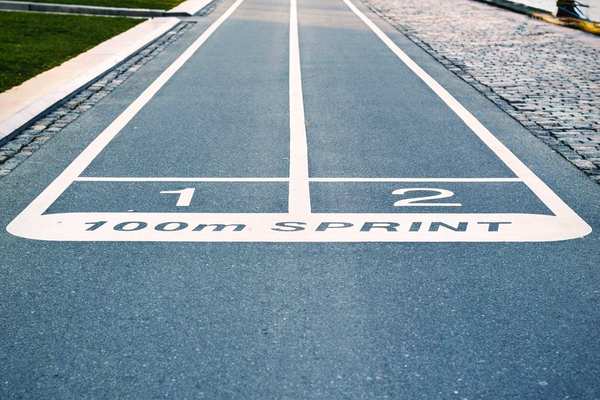
The 100m and 200m are both short sprints, but doubling the distance changes more than the time on the clock. In the 100m, athletes accelerate along a straightaway and fight to preserve maximum speed. In the 200m, they must accelerate on a bend, transition onto the straight and keep moving efficiently as fatigue builds.
Understanding 100m vs 200m sprinting is useful for choosing an event, planning training or appreciating why equally fast athletes can produce different results at the longer distance.
100m vs 200m: The Essential Differences
The 100m takes place entirely on a straight. Its defining demands are a responsive start, forceful acceleration, high top speed and minimal deceleration. The 200m covers half of a standard outdoor track, beginning on the curve and finishing on the home straight. Staggered starting positions allow every athlete to cover the same distance.
Both events require power, coordination and speed, but the 200m adds high-speed bend running and greater speed endurance. That does not make the 100m less technical. Its shorter duration gives athletes fewer opportunities to recover from an inefficient start or disrupted rhythm.
Starts and Acceleration
The 100m: Building Speed on a Straight
An effective 100m race strategy starts in the blocks. Sprinters drive powerfully through their first steps, then rise gradually as their stride length and speed increase. Standing upright too early can reduce the effectiveness of acceleration. Reaching forward with the foot to manufacture longer strides can also interrupt rhythm.
A fast reaction helps, but it is only one part of the performance. A runner with a slightly slower opening can still win through better acceleration and maximum velocity. The goal is a technically clean sequence rather than a frantic scramble over the first ten metres.
The 200m: Accelerating While Turning
The 200m also begins from blocks, but the initial acceleration occurs on a bend. Sprinters must develop speed while controlling their body position and staying in their assigned lane. They cannot simply copy their straight-line start without accounting for the curved path.
The opening is still aggressive. Holding back dramatically usually sacrifices valuable speed, although athletes differ in how they distribute effort. The important distinction is combining purposeful acceleration with enough relaxation to run the curve efficiently.
Why Curve Running Matters So Much
The curved opening makes the 200m technically distinct. Moving quickly around a bend requires forces that continuously redirect the runner’s path. Balance, ground contact and body alignment deserve attention alongside raw speed.
A controlled inward lean may help runners negotiate the bend, but exaggerated bending at the waist can disturb mechanics. Athletes aim to keep their hips tall, their arms coordinated and their foot strikes responsive to the track. There is no perfect lean angle or foot position that fits everyone.
The change from bend to straight should feel smooth, not like starting a new race. A runner who twists or abruptly changes posture at the exit may lose momentum. Practising that transition is valuable for athletes whose 200m finishes disappoint despite strong straight-line speed.
Maximum Velocity and Speed Endurance
The 100m is heavily influenced by how quickly a runner reaches top speed and how well that speed is preserved. Even elite athletes cannot remain at their absolute maximum velocity indefinitely. The closing metres reward efficient mechanics and resistance to deceleration.
The 200m extends this challenge. Speed endurance is the ability to sustain high running speeds while limiting the slowdown associated with fatigue. Near the finish, tired athletes may tense their shoulders, lose hip position or struggle to maintain stride rhythm.
This explains why 100m personal bests do not perfectly predict 200m performance. A brilliant starter might fade late, while another athlete with a less impressive opening may carry speed more effectively through the final straight. Strong 200m competitors combine raw speed with the ability to express it for longer.
Different Race Strategies
100m Race Strategy: Commit and Stay Relaxed
There is little room for tactical pacing in the 100m. Athletes concentrate on their own execution: powerful initial steps, progressive acceleration, relaxed high-speed mechanics and running through the finish. Forcing the shoulders or clenching the hands does not create more speed; unnecessary tension can interfere with efficient movement.
200m Race Strategy: Fast, Controlled and Continuous
A useful 200m race strategy connects the bend and straight rather than treating them as separate sprints. Runners accelerate hard, maintain coordinated movement around the curve and focus on posture and rhythm when fatigue rises. Some athletes attack the bend aggressively; others find a different effort pattern suits their strengths.
There is no universal split or instruction to run the opening 100m at a fixed percentage. The better principle is to avoid wasted movement while sustaining high speed throughout the race. Cruising through the curve can leave too much ground to recover.
A Practical Way to Find Your Stronger Event
Picture two athletes who record similar 100m times. One accelerates quickly but looks strained over the last 50m of a 200m. The other starts less explosively yet runs the bend smoothly and finishes with steadier form. The first may be more competitive in the 100m; the second may have an advantage at 200m.
To assess your profile, compare properly warmed-up runs across several sessions. Film short accelerations, the bend-to-straight transition and the final 50m of a longer effort. Look for changes in posture and rhythm rather than judging only by the stopwatch. Wind, fatigue and track conditions affect results, so involve a qualified coach where possible.
How Training Emphasis Changes
Both events benefit from strength work, acceleration practice, upright sprint mechanics and adequate recovery. Training emphasis differs. The 100m often places greater priority on block starts, short accelerations and flying sprints performed with full recovery. The 200m typically adds curve-specific practice, transitions into the straight and carefully managed longer repetitions to build speed endurance.
More exhaustion does not automatically produce better sprinting. High-speed running is demanding, and sufficient rest between intense efforts helps athletes practise quality mechanics. Useful related topics include sprint start technique, curve running drills and speed endurance workouts.
Frequently Asked Questions
Is the 200m twice as difficult as the 100m?
No. The longer race adds curve mechanics and greater fatigue, so the challenges differ rather than simply double.
Which event demands more speed endurance?
The 200m generally requires more speed endurance because athletes must sustain high velocity for longer. The 100m also rewards limiting slowdown near the finish.
Can a 100m specialist become a strong 200m runner?
Yes. Many sprinters compete in both events. Success at 200m also depends on curve efficiency and maintaining speed over the additional distance.
Which sprint should a beginner try first?
Beginners can learn safe acceleration and straight-line mechanics, then explore the 200m with appropriate coaching. Trying both can reveal different strengths.
Choosing Between the 100m and 200m
The clearest sprint event comparison is that the 100m emphasizes explosive straight-line performance, while the 200m adds bend running, prolonged speed and rhythm management. Neither is automatically easier. Your best event depends on how you accelerate, hold form and enjoy developing in training.