
Rugby union can look chaotic when you first watch it: players run into contact, the ball disappears beneath a crowd, and the referee awards a kick. Yet most passages follow a simple pattern. A team tries to move forward, protect the ball when tackled and find space to score. Learn that pattern and the rugby union rules become easier to follow.
The aim of rugby union
Two teams of 15 compete to score more points than their opponents. A standard senior match has two 40-minute halves. Each team attacks the opposition’s try line and defends its own. Forwards generally contest possession and carry into contact; backs often organise wider attacks. These are roles, not restrictions on who may score.
Unlike some other field sports, rugby does not stop after every tackle. Keeping possession through successive phases is central to the game, and one of the rugby union basics worth remembering.
How do teams score points?
Tries and conversions
A try earns five points when an attacking player legally grounds the ball in the opposition’s in-goal area. Merely crossing the line is not enough. After a try, the scoring team may attempt a conversion kick worth two additional points. The kick is taken in line with where the try was scored, explaining why players often run towards the posts before grounding the ball.
Penalty goals and drop goals
A successful penalty kick at goal earns three points. A drop goal also earns three, but it is kicked during open play after the dropped ball touches the ground. A penalty try, awarded when foul play prevents a probable try, is worth seven points without a conversion attempt.
For example, a converted try gives seven points, while two penalty goals give six. This difference often shapes decisions late in a close match.
Passing, running and kicking
Players may run forwards carrying the ball, but they must not throw or pass it forwards. Passes travel sideways or backwards; kicking forwards is allowed. Teammates can chase a kick if they comply with offside rules.
If a player accidentally loses the ball forwards from a hand or arm, that is generally a knock-forward, commonly called a knock-on. The usual restart is an opposing scrum. A deliberate forward throw or intentional knock-forward can instead bring a penalty. Viewing tip: watch the ball leave the passer’s hands rather than judging only where it lands.
What happens at a tackle?
A tackle brings a held ball-carrier to ground. Tackles must be legal and safe; high or dangerous contact can result in penalties and cards. The tackled player must make the ball available promptly, usually by placing or releasing it. The tackler must release the player and move away or regain their feet before competing for possession.
That creates an immediate contest. A defender on their feet who reaches the ball legally before a ruck forms may win it. Players cannot simply dive onto a tackled opponent or lie over the ball to block access.
Rucks and mauls are different
A ruck forms when opponents on their feet make contact over a ball on the ground. Players join from their own side, remain on their feet and generally cannot use their hands once the ruck has formed. A scrum-half commonly retrieves the ball from the back to launch another phase.
In a maul, the ball-carrier stays on their feet, held by an opponent, with a teammate also bound on. The group can drive forwards while the ball stays off the ground. See rugby ruck and maul differences for a closer comparison.
Offside: why players cannot stand anywhere
Offside concerns position and participation. At a ruck, each team has an offside line through the hindmost point of its participants. Teammates normally stay behind that line until the ball is out. Entering from the opponent’s side is another common infringement.
In open play, someone ahead of a teammate who kicks the ball may be offside. They must not interfere until put onside under the rugby laws. Watching the back foot of a ruck is a quick way to understand many referee decisions.
Scrums and lineouts: how play restarts
Scrums
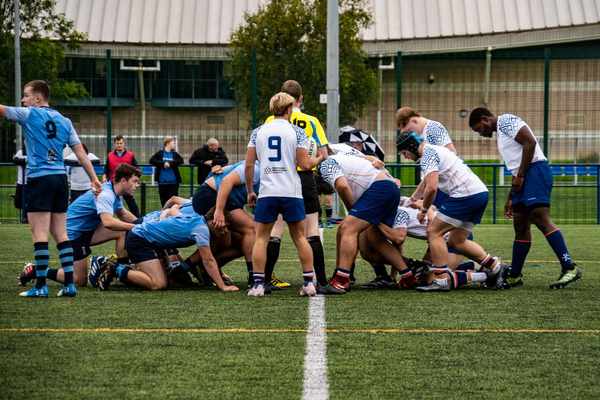
A scrum commonly restarts play after a minor mistake such as an accidental knock-forward. Eight forwards from each full-strength team bind in formation, and one side feeds the ball into the middle. Both teams compete to hook it back. The referee controls engagement for safety; illegally collapsing a scrum can bring a penalty.
Lineouts
When the ball goes over a touchline, play often restarts with a lineout. Players form two lines and compete for a throw between them, sometimes lifting a jumper. Usually the team that did not put the ball into touch throws in. An important exception is a penalty kick to touch, when the kicking team normally retains the throw.
Other tactical exceptions include the 50:22 kick. Beginners can explore those later through rugby lineout rules and tactics.
Penalties, free-kicks and advantage
Common penalty offences include dangerous tackling, offside and illegal entry into a ruck. After a penalty, a team may kick at goal, kick for territory or restart quickly with a tap. Free-kicks cover certain lesser infringements and cannot be kicked directly for a goal.
The referee may signal advantage instead of stopping immediately. This gives the non-offending side a chance to benefit from continuing play. If no suitable advantage develops, the referee can return to the original offence. That explains why a whistle sometimes arrives seconds after an infringement.
Following a match from kick-off to full-time
A half begins with a drop-kick from halfway. After points are scored, the non-scoring team restarts. Play alternates between open attacks, tackles, rucks, kicks and set-piece restarts. The referee manages stoppages and time; play can continue after the clock reaches 40 or 80 minutes until the ball becomes dead, subject to exceptions such as an outstanding penalty.
Try following three things during an attack. Who has possession? Where is the offside line after a tackle? Does the next pass, kick or carry improve field position? Those questions make rugby for beginners more approachable than memorising every technical sanction.
Frequently asked questions
Can you pass forwards in rugby union?
No. A hand pass must not travel forwards, although players can carry the ball forwards and kick it upfield.
How many players are on a rugby union team?
Fifteen normally start per side: eight forwards and seven backs. Substitutes depend on competition and match rules.
What is the difference between a scrum and a ruck?
A scrum is a structured restart after a stoppage. A ruck develops in live play around a ball on the ground.
Why does the referee let play continue after a foul?
The referee may be playing advantage, allowing the non-offending team to gain territory or an attacking opportunity.
Getting comfortable with the rules
You do not need every clause of the union match rules to enjoy a game. Start with five-point tries, backwards passing, legal tackles, onside positions and the difference between rucks, scrums and lineouts. Once those ideas click, the referee’s signals and tactical choices make sense. Rugby union positions and responsibilities is a natural next topic.