
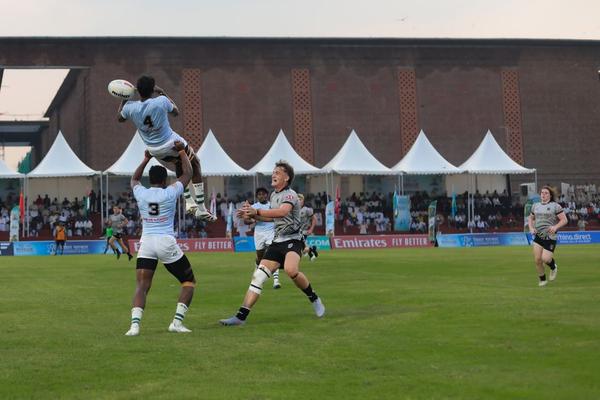
The Rugby World Cup Sevens format makes every early mistake feel enormous. Unlike a league-style competition where a team can recover from a poor opening result, the most recent World Cup Sevens used direct knockout matches to decide who could still become champion. A single defeat ended a team’s title hopes, even though it could continue playing for a final placing.
Rugby World Cup Sevens is a separate event from the annual international sevens circuit and the Olympic tournament. Its format has changed over time, so the clearest explanation comes from the 2022 edition in Cape Town, which followed the knockout approach introduced in 2018.
How does the Rugby World Cup Sevens format work?
At the 2022 event, 24 men’s teams and 16 women’s teams competed in separate competitions. Both had knockout championship brackets rather than an initial round-robin pool stage. Winners advanced toward the title; losing teams moved into placement competitions according to their results.
The championship path was straightforward: survive the opening match, win the round of 16, progress through the quarter-finals and semi-finals, and win the final. The men’s event added a preliminary round because its starting field was larger.
How teams qualify for World Cup Sevens
Sevens qualification happens before the tournament begins. For Cape Town 2022, the top eight men’s teams and top four women’s teams from the 2018 World Cup Sevens qualified automatically. South Africa’s women also received a host place. Other berths were largely decided through regional pathways across Africa, Asia, Europe, North America, Oceania and South America.
This produced an international field rather than simply inviting every team from the regular sevens circuit. Qualification rules can change between editions, so the 2022 allocations should not be treated as a permanent formula.
Seeding and why it matters
Qualifying answers who gets into the tournament; seeding determines where those teams appear in the draw. For 2022, World Rugby used points from relevant World Rugby Sevens Series seasons to seed the teams, with additional ranking considerations for sides outside the core circuit.
Seeds shape the route through the bracket. In the men’s competition, the eight highest seeds bypassed the preliminary round, while the remaining 16 teams played for the right to face them. This rewarded stronger recent performances without guaranteeing anyone a win.
The men’s knockout bracket: 24 teams
Preliminary round
The men’s field began with eight preliminary matches featuring seeds nine through 24. Eight winners emerged to join the eight teams that had received byes. Those 16 remaining sides then formed the main championship draw.
Round of 16 to the final
From there, the sevens knockout format followed familiar elimination stages: eight round-of-16 winners became four quarter-final winners, then two semi-final winners. Those finalists played for the men’s world title. Losing semi-finalists could still compete for bronze, but could no longer win gold.
To follow a men’s team, check its seed before looking at its first fixture. A highly seeded side might open in the round of 16, while a lower-ranked opponent must first survive an additional match. Comparing match totals without checking byes can make the schedule look confusing.
The women’s knockout bracket: 16 teams
The 2022 women’s championship started directly at the round of 16. All 16 teams had an opening knockout fixture, so there was no equivalent preliminary stage or group phase. Winners advanced to the quarter-finals, then the semi-finals and championship final. Even the top seed could be knocked out in its opening match.
What happens after a team loses?
Knockout does not necessarily mean going home immediately. At Cape Town, defeated teams entered different classification routes, including Challenge and, in the men’s competition, Bowl matches. Further fixtures settled placings beyond the championship medals.
These games mattered for final rankings and gave teams more competitive rugby. However, winning a Challenge or Bowl final did not make a team the Rugby World Cup Sevens champion. The world title belonged only to the winner of the championship final.
How the world champions are crowned
The men’s and women’s championship finals determine their respective winners. At the 2022 World Cup Sevens, Fiji beat New Zealand 29–12 in the men’s final. Australia edged New Zealand 24–22 in the women’s final. Ireland’s men and France’s women claimed the bronze medals.
Those examples show why an unbeaten championship run is central to the recent format. A side can have excellent tournament performances, but one loss in the title bracket changes what it can ultimately win.
World Cup Sevens versus the Olympics and SVNS
These events share seven-a-side rugby rules, but they are not interchangeable competitions. Olympic sevens has its own qualification system and tournament structure. The regular HSBC SVNS circuit combines results across multiple events, with a separate SVNS World Championship under the newer international model.
The HSBC SVNS World Championship held in 2026 is not another edition of Rugby World Cup Sevens. Its name can cause confusion when fans search for a ‘sevens world champion.’ Check which trophy, season and competition the result refers to.
For match fundamentals, a guide to rugby sevens rules helps explain the seven-minute halves, scoring and substitutions. A comparison with rugby sevens at the Olympics can explain why international medal events use different routes to a final.
A practical way to read the bracket
Imagine supporting a ninth-seeded men’s team in the 2022 draw. Its first job is to win a preliminary game; only then does it reach the round of 16 against a top-eight seed. By contrast, the higher-seeded opponent begins its campaign at that later stage. Both still need to win every championship match they play.
Before predicting a possible final, trace each team’s route one round at a time. Mark preliminary byes, distinguish championship fixtures from placement matches, and check whether a result sends the winner into the next title round. This habit makes a crowded rugby sevens tournament schedule easier to understand.
Frequently asked questions
Does Rugby World Cup Sevens have group stages?
Not in the 2018 and 2022 editions, which used straight knockout championship formats. Earlier tournaments have used different structures, and future organizers may change the format again.
Why did some men’s teams play an extra match in 2022?
There were 24 entrants but only 16 places in the main draw. Seeds nine to 24 played a preliminary round, while the highest eight seeds received byes.
Can a team become champion after losing a match?
Under the 2022 championship format, no. A defeat ended its world-title bid, though it could continue in classification fixtures to determine its final position.
Is the SVNS World Championship the same tournament?
No. The SVNS World Championship is part of World Rugby’s international sevens series structure; Rugby World Cup Sevens is a separate tournament with its own history and entry rules.
The key point for fans
The Rugby World Cup Sevens format is easiest to follow by separating qualification, seeding, title matches and placement games. In 2022, the larger men’s field needed an extra opening round, while the women’s field started with 16 teams. Once the title bracket began, there was no recovery route after defeat. That high-stakes design gave the World Cup a distinct identity alongside Olympic sevens and the annual circuit.